

Summary

- What Is Wire EDM in Medical Device Manufacturing?
- Why Use Wire EDM for Precision Medical Components?
- Wire EDM Applications in Surgical Tools
- Wire EDM Applications in Implants and Orthopedic Components
- Which Medical Materials Can Wire EDM Cut?
- Surface Integrity, Skim Cuts, and Process Validation
- How Accutex Supports Medical Device Manufacturing
- Frequently Asked Questions About Wire EDM for Medical Devices
- Building a Reliable Medical Wire EDM Process
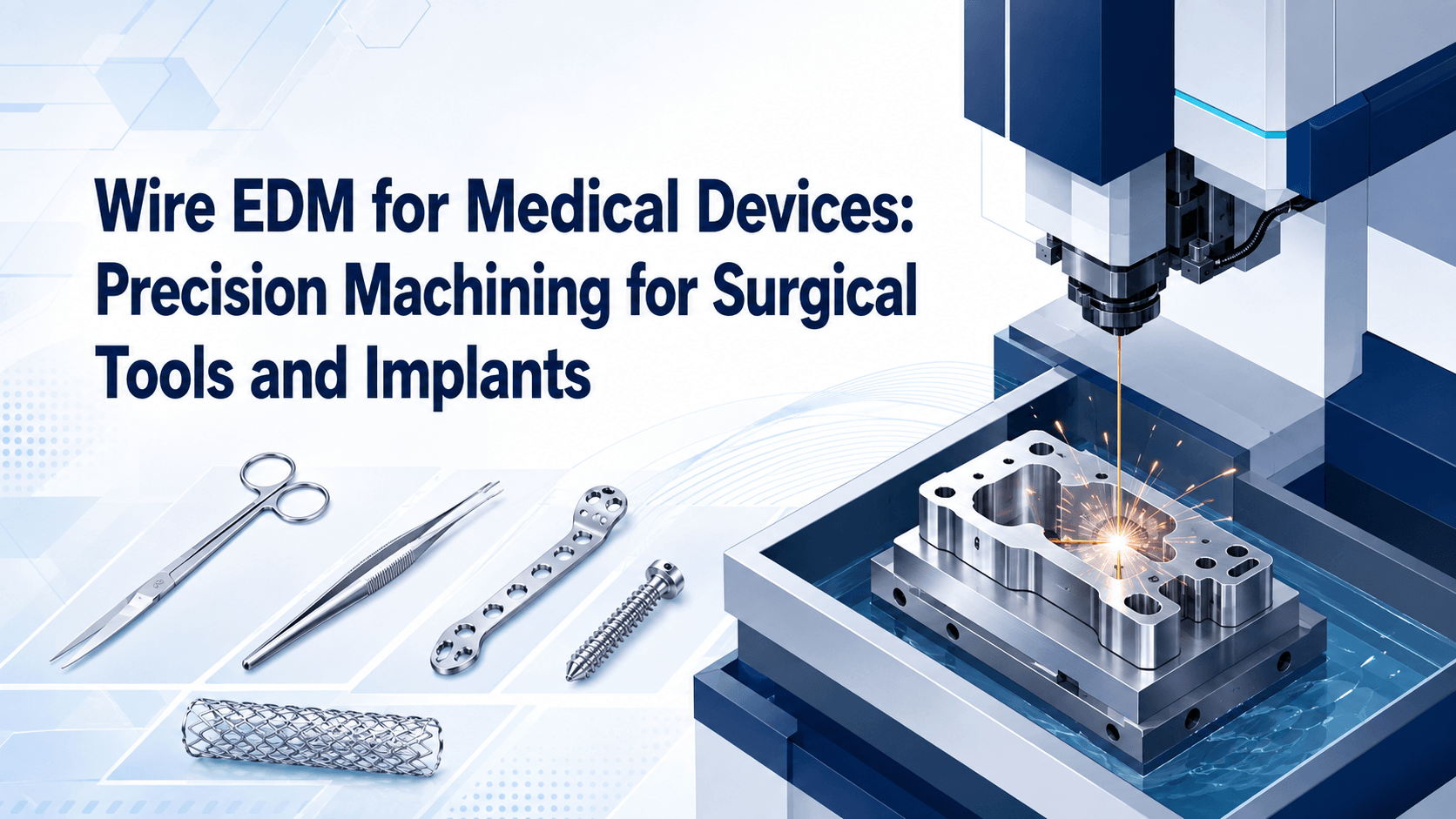
Medical device manufacturers work with demanding geometries, difficult-to-machine alloys, and strict quality requirements. Surgical instruments, orthopedic components, and production tooling may require narrow slots, small internal radii, tapers, or accurate contours without excessive cutting force. Wire electrical discharge machining - commonly called wire EDM or wire cut EDM—can address many of these challenges.
At Accutex, we have dedicated more than 26 years to advancing wire cut EDM technology. Our experience shows that medical manufacturing requires more than accuracy: stability, surface integrity, repeatability, traceable data, and the correct finishing strategy also matter.
What Is Wire EDM in Medical Device Manufacturing?
Wire EDM is a non-contact machining process that removes material through a controlled series of electrical discharges between a continuously moving wire electrode and an electrically conductive workpiece. The cutting zone is managed with deionized water, which cools the process, flushes away eroded particles, and helps maintain a stable discharge gap.
Because the wire does not mechanically push against the workpiece, wire EDM produces very low cutting force. This helps protect thin sections and delicate features from distortion. Material hardness is generally less important than electrical conductivity, allowing many challenging medical alloys to be processed after heat treatment.
Wire EDM is primarily a through-cutting process. An internal contour normally requires a start hole for threading the wire. Blind cavities are generally better suited to die-sinker EDM, while rotational features may be more efficient to turn or grind.
Why Use Wire EDM for Precision Medical Components?
The main advantages of wire EDM for medical device manufacturing include:
- High geometric accuracy: CNC-controlled wire movement can produce complex profiles, narrow openings, tapers, and detailed internal contours.
- Low machining force: Non-contact cutting helps reduce mechanical deformation in slender or delicate components.
- Capability with hard alloys: Conductive materials can be machined even when conventional cutting is difficult.
- Consistent feature production: Controlled rough cutting followed by one or more skim cuts can improve dimensional accuracy and surface finish.
- Reduced dependence on shaped tooling: Unlike die-sinker EDM, wire EDM uses a continuous wire electrode rather than a custom-formed copper or graphite electrode.
- Automation potential: Wire threading, simulation, alignment, and monitoring functions can support unattended machining.
Process selection should still consider geometry, material, tolerance, surface requirements, volume, inspection, and total cost.
Wire EDM Applications in Surgical Tools
Wire EDM can produce blanks, slots, openings, jaws, guides, and through-features for surgical scissors, forceps, clamps, and blade-related components.
It may efficiently establish the primary profile, but grinding, honing, polishing, coating, or passivation may still be needed to achieve the specified edge and surface performance.
Wire EDM also supports medical production tooling, including precision punches, dies, inserts, gauges, and fixtures. Cutting hardened tooling with minimal force helps maintain accurate clearances.
Wire EDM Applications in Implants and Orthopedic Components
Implant manufacturing uses conductive materials such as titanium, cobalt-chromium, medical stainless steel, and nickel-titanium. Wire EDM may be considered for orthopedic profiles, fixation components, openings, test coupons, prototypes, and selected geometries used in bone plates, implant systems, or stent-related production.
The process is useful for detailed two-dimensional or tapered through-profiles that are difficult to mill without deflection. Fine wire configurations can expand the range of small features, subject to machine capability, workpiece thickness, flushing, and corner requirements.
An implant is not ready for clinical use simply because it meets dimensional requirements. The complete route must address surface chemistry, recast layer, fatigue performance, cleaning, biocompatibility, sterilization compatibility, and applicable regulations. Wire EDM is one qualified step within a controlled process.
Which Medical Materials Can Wire EDM Cut?
Wire EDM can machine materials that conduct electricity. Common candidates in medical manufacturing may include:
- Stainless steels
- Titanium and titanium alloys
- Cobalt-chromium alloys
- Nickel-based alloys
- Nickel-titanium shape-memory alloys
- Conductive tool steels and carbide used for medical production tooling
Composition, heat treatment, thickness, internal stress, and conductivity affect cutting behavior and technology settings. Nonconductive polymers, ceramics, and glass cannot be cut directly by conventional wire EDM. Instead, the process may produce conductive molds, dies, or tooling used to manufacture polymer components.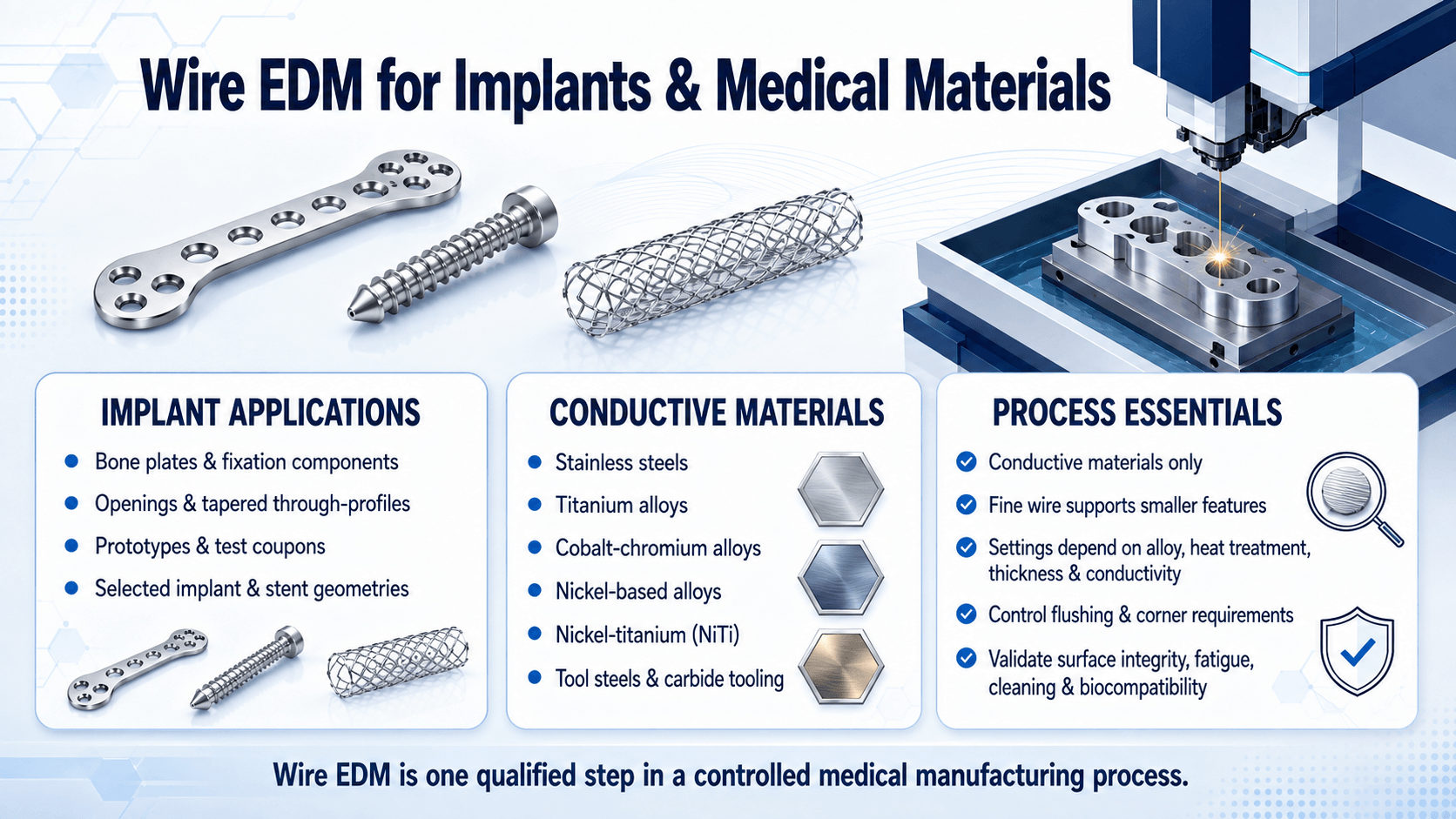
Surface Integrity, Skim Cuts, and Process Validation
Wire EDM removes material thermally. The surface may include microscopic craters, a recast layer, or other metallurgical changes whose significance depends on the material, energy, flushing, passes, and intended function.
A typical strategy uses a rough cut for material removal and skim cuts to improve geometry and surface condition. Critical components may also require polishing, electropolishing, passivation, heat treatment, cleaning, or other validated post-processing. Suitability may depend on fatigue, corrosion, edge condition, contamination control, and functional testing—not surface roughness alone.
Manufacturers should connect documented machining parameters to measurable acceptance criteria and inspection results. ISO 13485 provides a quality-management framework for medical device design and production. In the United States, the FDA's Quality Management System Regulation incorporates ISO 13485:2016. Requirements vary by market and device classification, and the finished-device manufacturer remains responsible for qualification, validation, risk management, and release.
How Accutex Supports Medical Device Manufacturing
Guided by technology, excellence, integrity, and participation, Accutex helps manufacturers match a stable wire EDM platform to their material, geometry, quality plan, and automation needs.
The Accutex AZ-400A and AZ-600A, identified in our medical application range, combine full closed-loop control with linear scales, rough- and skim-cut modes, automatic alignment, simulation, path display, and machining-history functions. Automatic wire threading and intelligent manufacturing capabilities can support repeatable, automated workflows. Selection should be based on travel, workpiece size, taper, wire configuration, tolerance, and target surface condition.
Our application approach begins with the part. We review the drawing, material, thickness, start-hole strategy, clamping, flushing, corners, inspection plan, and post-processing route before confirming the process.
Frequently Asked Questions About Wire EDM for Medical Devices
Can wire EDM machine titanium medical components?
Yes. Titanium alloys are electrically conductive and can be machined by wire EDM. Parameters and finishing steps must be selected according to the alloy, geometry, surface requirements, and intended function.
Does wire EDM create burr-free medical parts?
Wire EDM does not form conventional cutting-tool burrs, but edge condition must still be inspected. Recast material, sharp edges, loose particles, or handling damage may require secondary finishing.
Is wire EDM suitable for final implant surfaces?
It depends on the validated product and process requirements. Many implant applications require additional surface treatment, cleaning, and performance testing after EDM.
What information is needed to evaluate a medical wire EDM application?
Key inputs include the drawing, conductive material and heat-treatment condition, workpiece dimensions, tolerances, surface specification, production volume, inspection method, and downstream finishing requirements.
Building a Reliable Medical Wire EDM Process
Wire EDM can provide the accuracy, geometric freedom, and low cutting force needed for surgical tools, implant components, and medical tooling. Its value is strongest when machine capability is combined with parameter control, skim cutting, surface-integrity planning, inspection, and validation.
With decades of wire EDM research and development, Accutex helps manufacturers turn demanding conductive components into stable machining processes. By evaluating the complete route—not only the cut—we support accuracy, consistency, and long-term performance.