

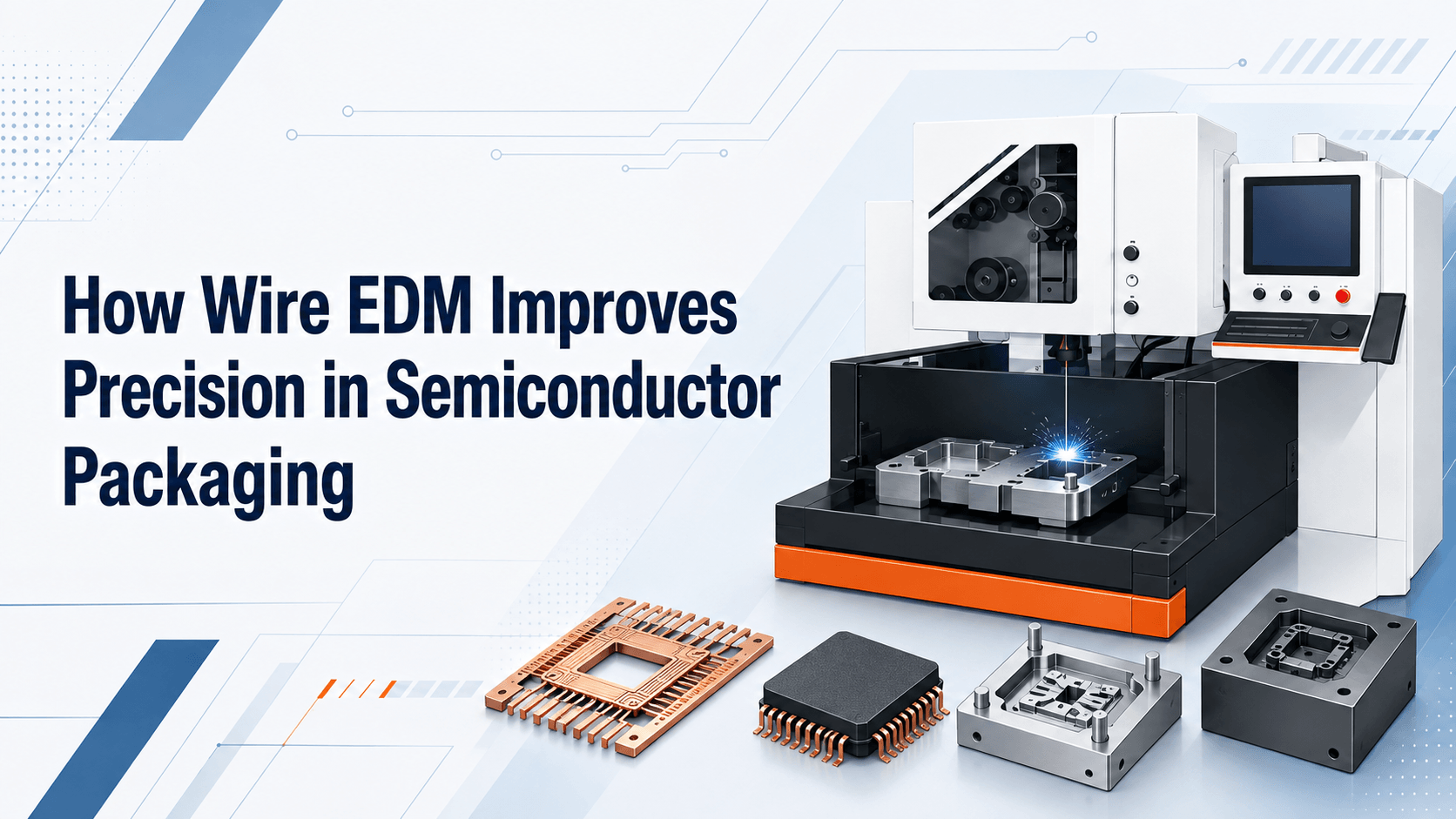
Wire electrical discharge machining, or Wire EDM, improves semiconductor packaging precision primarily by producing accurate tooling and conductive components without conventional cutting force. It is especially valuable for lead-frame stamping dies, encapsulation mold components, trim-and-form tools, gauges, fixtures, and selected prototypes.
Summary

At Accutex, we apply more than 26 years of Wire EDM research and development to demanding manufacturing applications. This article explains where Wire EDM fits into semiconductor packaging, how it improves accuracy, and what manufacturers should consider when selecting the process and equipment.
Why Precision Matters in Semiconductor Packaging
A semiconductor package protects the die, provides electrical connections, manages heat, and enables circuit-board assembly. Small tooling errors can affect lead position, mold alignment, package geometry, sealing quality, and downstream production.
As packages become smaller and more densely interconnected, toolmakers must control feature dimensions, punch-to-die clearance, corner geometry, mold alignment, surface condition, and replacement-part consistency. Milling, grinding, die-sinker EDM, laser processing, and Wire EDM may all contribute. Wire EDM is selected when a conductive part requires a precise through-cut, narrow slot, intricate contour, or low-force machining process.
How Does Wire EDM Work?
Wire EDM is a CNC-controlled electrical discharge process. A thin wire electrode travels between precision guides while the workpiece is submerged in or flushed with deionized water.
The wire never touches the material. Controlled electrical pulses create sparks across a microscopic gap, and each discharge removes a small amount of conductive material. The water cools the area, stabilizes the process, and carries away debris.
A rough cut removes most of the material. One or more skim cuts can then improve dimensional accuracy, corner quality, and surface finish. Because performance depends mainly on electrical conductivity rather than conventional machinability, Wire EDM can process hardened tool steels, tungsten carbide, and other conductive tooling materials.
How Wire EDM Improves Packaging Precision
Minimal Mechanical Cutting Force
Conventional tools push against the workpiece and can introduce deflection, vibration, or burrs. Wire EDM removes material through spark erosion and creates almost no mechanical cutting force. This benefits narrow die sections, delicate inserts, thin features, and details that could deform under tool pressure.
Machining After Heat Treatment
Packaging tools often use hardened steel or carbide for wear resistance. Wire EDM can machine many conductive tool materials after heat treatment, allowing critical profiles and clearances to be finished closer to their final condition. This helps reduce the risk of distortion from hardening after final machining.
Intricate Profiles and Fine Features
The wire follows programmed paths to create complex through-profiles, narrow slots, small internal radii, and tapered features. These capabilities support closely spaced die details, precision inserts, trim-and-form tooling, and gauges.
The achievable radius and feature size depend on wire diameter, discharge gap, material thickness, flushing, and machine configuration. Tool geometry should therefore be reviewed before process selection.
Controlled Finish and Edge Quality
The rough cut prioritizes material removal, while lower-energy skim cuts refine geometry and surface finish. A suitable skim-cut strategy can reduce roughness, improve corner accuracy, and manage the thermally affected layer produced by spark erosion.
Surface requirements should match the tool’s function. Cutting edges, mold inserts, sliding components, and inspection gauges may need different combinations of speed, finish, and surface integrity.
Repeatability and Tool Replacement
Packaging lines depend on replaceable punches, dies, inserts, and wear parts. CNC programs, standardized setups, and controlled machining parameters help toolmakers reproduce these components consistently. Reliable replacement geometry can reduce adjustment time when tooling returns to production.
Automation and Process Records
Modern Wire EDM systems may include automatic alignment, wire threading, program simulation, machining records, and remote monitoring. These functions reduce manual variation and make approved process conditions easier to repeat and review.
For quality-sensitive semiconductor operations, better process visibility can support traceability and preventive maintenance.
Wire EDM Applications in Semiconductor Packaging
Lead-Frame Stamping Tooling
Lead frames provide electrical paths between the semiconductor die and external terminals. High-volume lead frames are commonly manufactured by stamping or etching. Wire EDM contributes by producing hardened punches, die openings, inserts, and related stamping tools.
Accurate punch-to-die clearance and profile geometry help manage burrs, dimensional consistency, and tool life. Wire EDM may also support development parts or limited-volume conductive profiles when production requirements are suitable.
Encapsulation Mold Components
Encapsulation protects the die and interconnections with molding compound. Wire EDM can produce conductive mold inserts, slots, through-features, and alignment components requiring precise geometry.
Not every mold feature is suitable for wire cutting. Milling or die-sinker EDM is usually more effective for three-dimensional blind cavities. Selecting the process according to feature geometry improves both accuracy and efficiency.
Trim-and-Form Tooling
After molding, packages may require trimming, separation, and lead forming. Wire EDM can manufacture precision punches, dies, guides, and profiles used in trim-and-form tools. Low cutting force and hardened-material capability are useful where small clearances and repeatable geometry are essential.
Fixtures, Gauges, and Machine Components
Packaging operations also use positioning fixtures, inspection gauges, nests, and precision equipment components. Wire EDM creates accurate conductive profiles for these supporting tools, helping maintain alignment and consistent handling during assembly and inspection.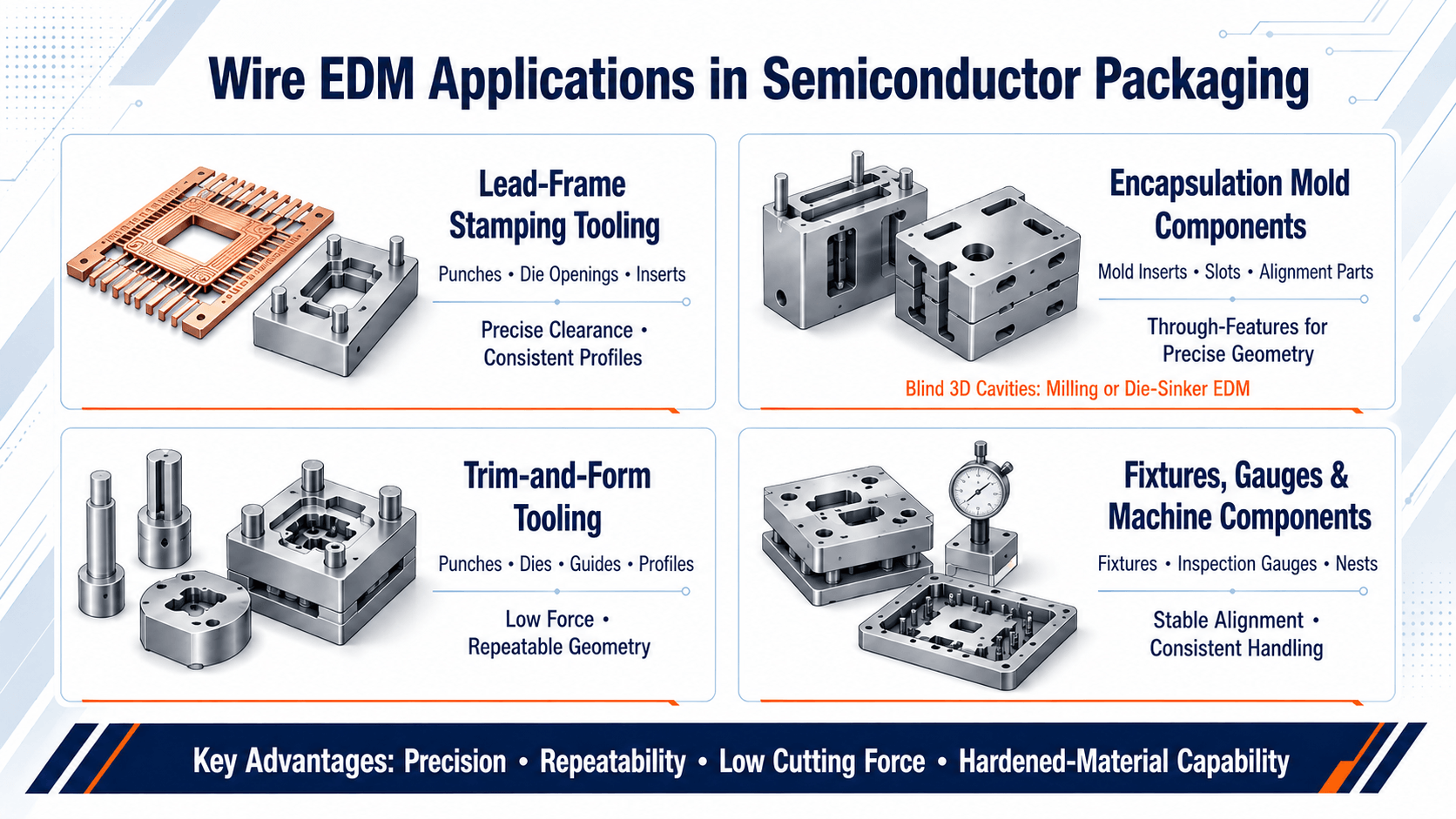
Which Factors Affect Wire EDM Accuracy?
Machine resolution alone does not determine the result. Important variables include:
- Wire material, diameter, tension, and feed
- Pulse energy and servo-gap control
- Flushing conditions and water quality
- Workpiece material and thickness
- Temperature and machine stability
- Fixturing and material stress
- Rough- and skim-cut strategy
- Calibration, maintenance, and inspection
For critical packaging tooling, manufacturers should define dimensional tolerance, surface finish, edge condition, recast-layer limits, and inspection criteria before machining.
Choosing Wire EDM for Semiconductor Packaging
Toolmakers should evaluate workpiece capacity, accuracy, repeatability, machine rigidity, taper capability, fine-feature requirements, controller functions, automatic wire threading, process records, application support, and lifecycle service.
Accutex identifies the AZ-400A and AZ-600A as solutions for semiconductor applications. Depending on model and configuration, AZ Series functions include full closed-loop linear-scale control, rough and skim-cut modes, automatic alignment, built-in CAD/CAM, processing-history records, EtherCAT-based control, and Industry 4.0 connectivity. These features help manufacturers establish stable, traceable, and increasingly automated machining processes.
Guided by Technology, Excellence, Integrity, and Participation, Accutex works with customers and partners to share application knowledge, solve production challenges, and support long-term improvement.
Frequently Asked Questions
Is Wire EDM Used to Manufacture Every Lead Frame?
No. High-volume lead frames are generally stamped or etched. Wire EDM is particularly valuable for producing the dies, punches, inserts, and related tooling used in those processes. It may also support prototypes or selected conductive parts.
Can Wire EDM Cut Semiconductor Wafers Directly?
Standard Wire EDM requires an electrically conductive workpiece. Wafer materials vary in conductivity, structure, and manufacturing requirements, so direct wafer cutting is not universally suitable. Within semiconductor packaging, Wire EDM is most consistently applied to conductive tooling and equipment components.
Does Wire EDM Produce Burr-Free Surfaces?
Wire EDM does not create conventional cutting burrs because no physical cutting edge contacts the part. However, it is a thermal process and may leave a thin recast or affected layer. Suitable energy settings, flushing, and skim cuts help manage the surface.
Can Wire EDM Create Blind Mold Cavities?
Standard Wire EDM requires a continuous wire path and is mainly used for through-features. Die-sinker EDM or milling is normally more suitable for blind three-dimensional cavities.
Conclusion
Wire EDM improves semiconductor packaging precision through accurate, repeatable machining of hardened dies, punches, mold components, trim-and-form tools, fixtures, and gauges. Its low cutting force, complex-profile capability, skim-cut control, and automation potential make it valuable for modern packaging-tool production.
With decades of focused development, Accutex helps manufacturers build stable processes for increasingly demanding semiconductor applications.