

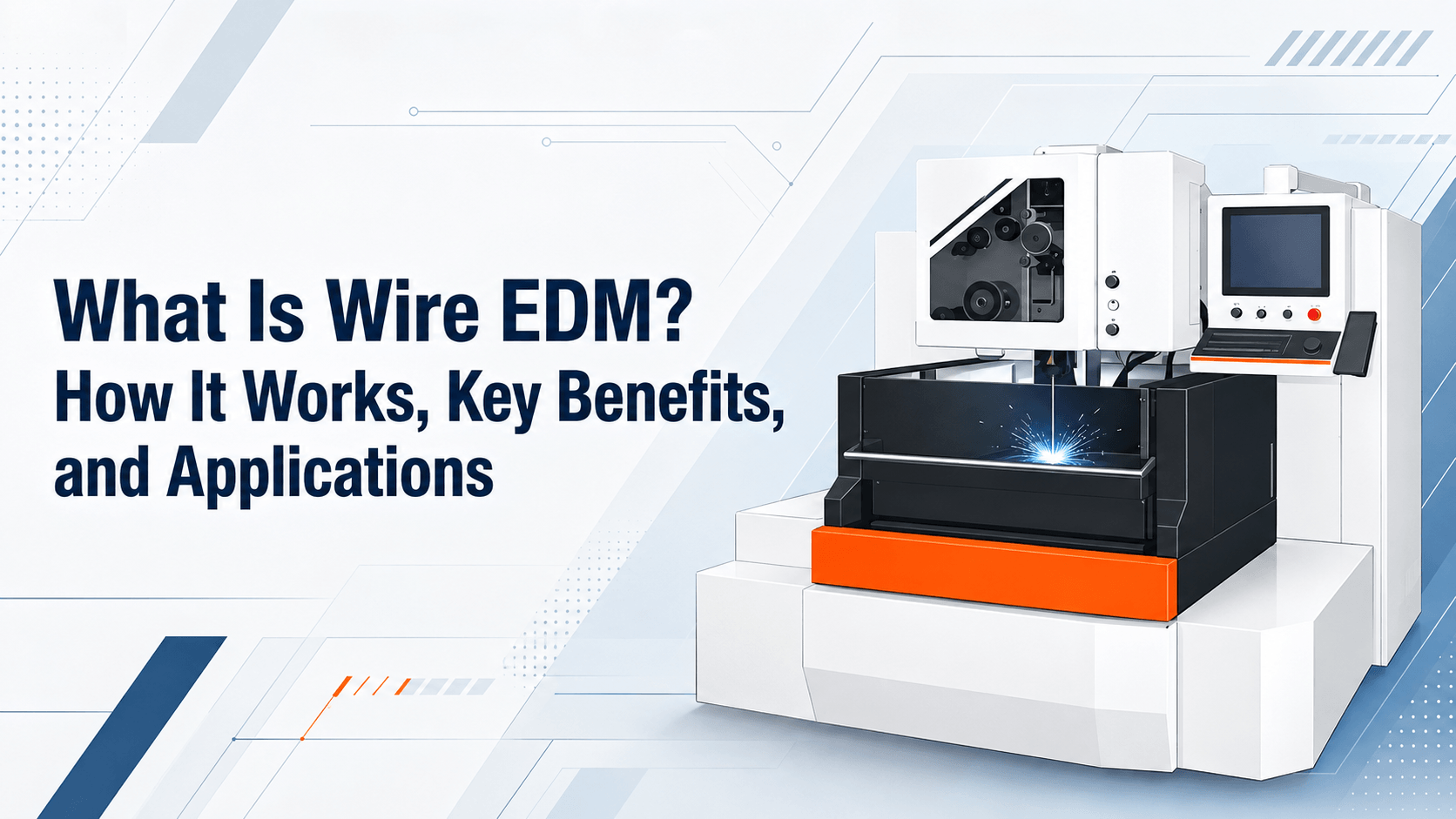
Wire electrical discharge machining, commonly called Wire EDM, is a non-contact precision process that uses controlled electrical sparks and a continuously moving wire electrode to cut conductive materials. It is widely used for hardened metals, intricate profiles, narrow slots, and components requiring tight tolerances.
Summary

At Accutex, we have spent more than 26 years developing wire-cut EDM technology. This guide explains how Wire EDM works, its benefits, suitable materials, major applications, and the factors manufacturers should consider when choosing a machine.
What Is Wire EDM?
Wire EDM—also known as wire-cut EDM or WEDM—is a CNC-controlled form of electrical discharge machining. A thin brass or coated wire travels between precision guides while deionized water surrounds or flushes the workpiece.
The wire never touches the part. Controlled voltage creates repeated sparks across a microscopic gap, removing tiny amounts of metal through localized melting and vaporization. The dielectric water cools the area, stabilizes discharges, and carries away debris.
Wire EDM only works with electrically conductive materials and is mainly used for through-cuts. Die-sinker EDM is generally better for blind cavities.
How Does Wire EDM Work?
A typical process includes six steps:
- Prepare the workpiece: Secure the conductive material. An enclosed profile normally requires a starting hole for wire threading.
- Program the path: The CNC program defines geometry, cutting route, taper angle, and machining conditions.
- Feed the wire: Wire moves continuously from a spool through upper and lower guides under controlled tension.
- Generate sparks: Rapid electrical pulses remove material while servo control maintains the discharge gap.
- Flush the gap: Deionized water cools the area and removes microscopic debris.
- Apply rough and skim cuts: The rough cut removes most material; skim cuts refine accuracy, corners, and surface finish.
Results depend on wire diameter, pulse settings, flushing, material, thickness, temperature, and machine stability. A capable controller and proven machining database help operators maintain consistency.
What Are the Key Benefits of Wire EDM?
High Precision and Repeatability
Wire EDM can produce highly accurate profiles when the machine, workpiece, tooling, and parameters are properly controlled. It is valuable for dies, inserts, gauges, and components requiring repeatable dimensions.
Complex Cutting Capability
It can create intricate contours, narrow slots, small internal radii, detailed features, and tapered surfaces that may challenge conventional tools. Results depend on wire diameter, spark gap, workpiece thickness, and machine configuration.
Effective Cutting of Hardened Materials
Because performance depends mainly on conductivity rather than hardness, Wire EDM can cut material after heat treatment. This may reduce dimensional changes that could occur if a nearly finished part were hardened later.
Minimal Mechanical Force
The wire does not press against the workpiece, so the process creates almost no conventional cutting force. It is suitable for delicate details and slender sections, although secure fixturing remains essential.
Fine Finish and Minimal Burrs
Controlled spark erosion forms clean edges with little conventional burr formation. Skim cuts can further improve accuracy and surface quality, reducing secondary finishing for suitable parts.
Automation Potential
Automatic wire threading, probing, process databases, core removal, and remote monitoring can support unattended machining, increase equipment utilization, and improve production predictability.
Wire EDM is not ideal for every part. Laser cutting may be faster for simple thin-sheet profiles, while milling is often better for accessible three-dimensional features. Wire EDM provides the greatest value when accuracy, hard conductive materials, complex through-cuts, and low cutting force are priorities.
What Materials Can Wire EDM Cut?
Common materials include:
- Tool steel, hardened steel, and stainless steel
- Tungsten carbide
- Titanium and titanium alloys
- Nickel-based and heat-resistant alloys
- Aluminum
- Copper, brass, and other conductive alloys
Standard Wire EDM cannot cut nonconductive plastics, wood, ordinary glass, or most ceramics. Material composition, thickness, heat treatment, and required surface integrity should be reviewed before production.
Common Wire EDM Applications
Wire EDM is used wherever precise and repeatable through-cutting is required:
- Mold and die manufacturing: Punches, stamping dies, extrusion dies, mold inserts, and die components.
- Aerospace: Detailed profiles and slots in hard, heat-resistant alloys.
- Medical manufacturing: Fine features in surgical instruments, tooling, and selected medical components.
- Automotive and electric vehicles: Stamping tools, precision motor or transmission components, gauges, and fixtures.
- Semiconductor and electronics: Precision tooling, connector components, fixtures, and small conductive parts.
- General precision engineering: Gears, splines, keyways, micro-slots, prototypes, and complex machine parts.
For these industries, performance involves more than accuracy. Surface integrity, traceability, stability, automation, and technical support may be equally important.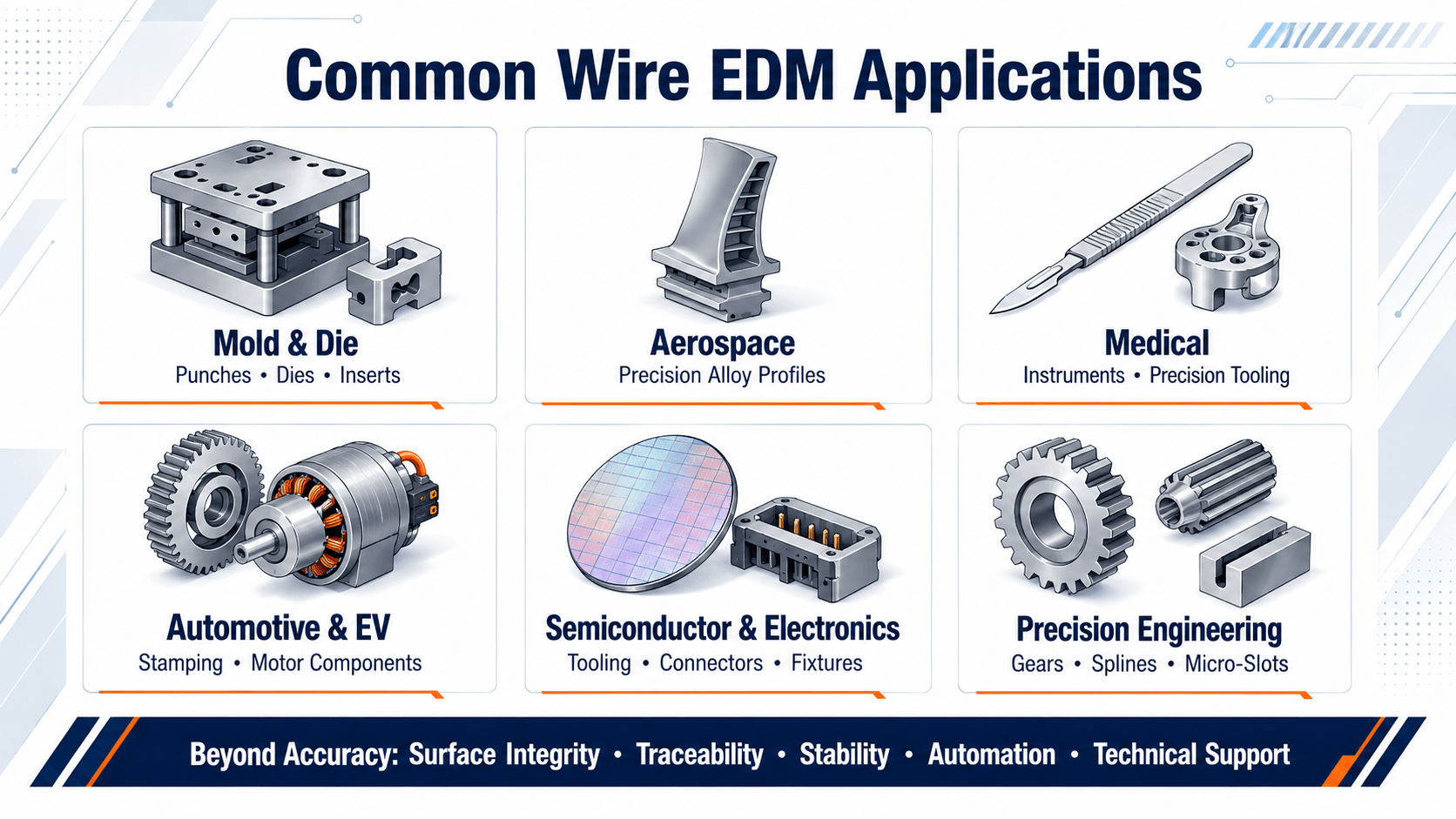
Wire EDM vs. Other Cutting Processes
Wire EDM removes material by spark erosion, CNC milling uses a physical tool, and laser cutting uses a focused thermal beam. Milling can create three-dimensional surfaces and blind features but generates tool wear and cutting force. Laser cutting is productive for many sheet parts but may face thickness, tolerance, or heat-effect limitations.
Wire EDM is particularly effective for hard conductive materials, intricate through-profiles, tight tolerances, and delicate features. It often complements milling, grinding, drilling, and laser cutting rather than replacing them.
How to Choose a Wire EDM Machine
Manufacturers should evaluate:
- Workpiece capacity: Axis travel, table load, tank size, and maximum workpiece weight.
- Accuracy and finish: Machine construction, motion control, generator performance, and skim-cut capability.
- Wire range: Fine-wire capability for small radii and micro-features.
- Taper requirements: U/V-axis travel and control performance for angled profiles.
- Automation: Automatic threading, probing, core removal, monitoring, and robotic integration.
- Controller and support: An effective interface, process database, training, and application assistance.
- Lifecycle value: Energy use, consumables, maintenance, spare parts, and local service.
Accutex Wire EDM Solutions
Accutex develops machines for standard precision cutting, high-end automated production, and large-workpiece machining. Our AP, AZ, AL, GA, and AU Series allow manufacturers to select equipment according to accuracy, capacity, automation, and investment needs.
Selected AP Series configurations support 0.07–0.1 mm fine wire, real-time monitoring, and automatic final core removal. The AU Series uses a moving-column design for large, heavy workpieces. Accutex also combines probing, intelligent manufacturing systems, robotics, and automated core removal to support Industry 4.0 production.
Guided by Technology, Excellence, Integrity, and Participation, we aim to help customers establish stable processes, improve productivity, and pursue long-term growth through technical knowledge and dependable service.
Frequently Asked Questions About Wire EDM
Does the Wire Touch the Workpiece?
No. Servo control maintains a microscopic gap, and electrical sparks remove the material.
How Accurate Is Wire EDM?
Wire EDM can achieve micrometer-level precision under suitable conditions. Actual accuracy depends on the machine, part size, material, temperature, fixturing, wire, parameters, and skim cuts.
Does Wire EDM Affect the Surface?
Because it is a thermal process, a thin recast or thermally affected layer may form. Appropriate energy settings, flushing, and skim cuts can manage it. Critical parts should have defined surface-integrity requirements.
Can Wire EDM Create Blind Cavities?
Standard Wire EDM is intended for through-cuts. Die-sinker EDM is normally used for blind cavities, while EDM drilling can create small starting holes.
Conclusion
Wire EDM is a proven solution for complex through-profiles in conductive materials, offering high accuracy, minimal mechanical force, and repeatability. Selecting the right system requires evaluating geometry, material, finish, automation, service, and lifecycle cost. With decades of focused research and development, Accutex helps manufacturers turn demanding designs into stable, productive machining results.