

Summary

- How Does the Wire Cut EDM Process Work?
- 1. Pulse-On Time (TON): How Long Does Each Spark Last?
- 2. Pulse-Off Time (TOFF): How Long Does the Spark Gap Recover?
- 3. Peak Current (IP): How Strong Is Each Discharge?
- 4. Servo Voltage (SV): How Is the Spark Gap Controlled?
- Quick Comparison of the Four Wire EDM Parameters
- How Do the Four Parameters Work Together?
- What Other Wire Cut EDM Settings Matter?
- Frequently Asked Questions About Wire EDM Parameters
- Selecting the Right Wire Cut EDM Solution
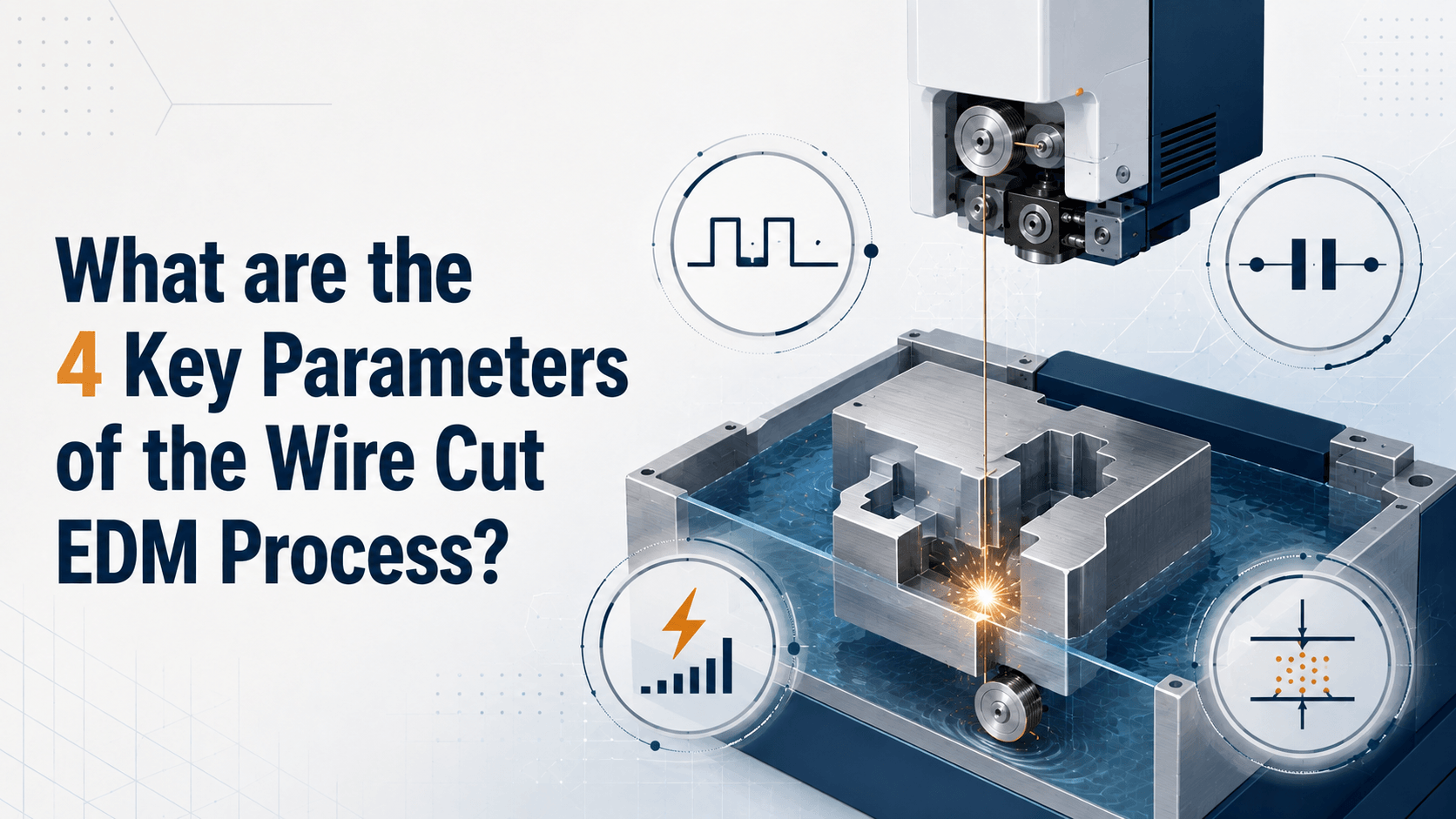
The four key parameters commonly used to control the wire cut EDM process are pulse-on time (TON), pulse-off time (TOFF), peak current (IP), and servo voltage (SV). Together, they determine how much discharge energy reaches the workpiece, how frequently sparks occur, and how the machining gap is maintained.
These parameters influence cutting speed, material removal rate, surface roughness, accuracy, stability, and wire-breakage risk. No single combination works for every material or machine; wire conditions, flushing, and workpiece thickness also matter.
Successful wire EDM is therefore about balancing settings for the part, tolerance, finish, and production objective—not maximizing one value.
How Does the Wire Cut EDM Process Work?
Wire cut electrical discharge machining, or WEDM, uses a continuously fed metal wire as the electrode. A CNC system guides it along a programmed path.
The wire does not touch the workpiece. Controlled sparks cross a small gap and remove microscopic amounts of conductive material. Deionized water cools the zone, controls discharges, and flushes away debris.
Thousands of discharges produce precise through-profiles, slots, tapers, and complex contours. Their energy and stability depend heavily on the following parameters.
1. Pulse-On Time (TON): How Long Does Each Spark Last?
Pulse-on time is the duration of each electrical discharge. A longer TON generally transfers more energy, creates a larger crater, and can increase material removal.
Increasing TON may improve rough-cutting speed, but too much can cause a rougher surface, thermal loading, instability, or wire breakage. Shorter TON is often preferred for skim cuts and delicate features.
Select TON according to roughing or finishing priorities, material, thickness, wire, flushing, and generator design.
2. Pulse-Off Time (TOFF): How Long Does the Spark Gap Recover?
Pulse-off time is the interval between discharges. It lets the dielectric deionize, cool the zone, and remove debris.
A shorter TOFF permits more discharges and may increase speed. If it is too short, retained debris can cause arcing, short circuits, poor surface integrity, or wire breakage.
A longer TOFF improves gap recovery and stability, especially in thick or difficult-to-flush workpieces, but may slow machining. Use enough off-time for stable cutting without unnecessarily reducing productivity.
3. Peak Current (IP): How Strong Is Each Discharge?
Peak current is the maximum current reached during a discharge. Together with TON, it controls spark energy.
Higher IP can increase rough-cutting removal, but may also create larger craters, roughness, thermal impact, wire loading, and rupture risk.
Lower IP produces gentler discharges suited to finishing and fine details. Because IP interacts closely with TON, optimize them together rather than independently.
4. Servo Voltage (SV): How Is the Spark Gap Controlled?
Servo voltage is a control reference for regulating the distance between wire and workpiece. The controller adjusts axis feed to keep the spark gap stable.
Generally, higher SV produces a wider average gap, improving flushing and reducing shorts but possibly lowering efficiency. Lower SV narrows the gap and may increase discharge activity, but can cause instability or breakage.
The exact response is controller-specific. Follow the machine builder’s technology data rather than copying numerical settings from another system, especially for corners, thickness changes, and difficult flushing.
Quick Comparison of the Four Wire EDM Parameters
| Parameter | Primary Function | If Increased, It Commonly Tends to… | Main Risk When Poorly Balanced |
|---|---|---|---|
| Pulse-on time (TON) | Controls discharge duration | Increase energy and rough-cutting speed | Rough surface, thermal load, wire breakage |
| Pulse-off time (TOFF) | Provides recovery between sparks | Improve flushing and cutting stability | Excessive cycle time and lower productivity |
| Peak current (IP) | Controls discharge intensity | Increase material removal | Large craters, roughness, wire loading |
| Servo voltage (SV) | Regulates the machining gap | Widen the average gap and improve stability | Reduced efficiency if the gap is excessive |
These are general tendencies; actual results depend on interactions, workpiece conditions, and control logic.
How Do the Four Parameters Work Together?
Wire EDM optimization is multi-objective. Longer TON and higher IP may improve roughing productivity but reduce finish and stability. Sufficient TOFF and appropriate SV help the gap recover.
Finishing normally uses lower energy and skim cuts to improve roughness, straightness, and accuracy. Skim-pass settings should not copy roughing settings.
Begin with tested technology settings, adjust one condition at a time, and verify speed, gap stability, finish, dimensions, and wire-breakage history.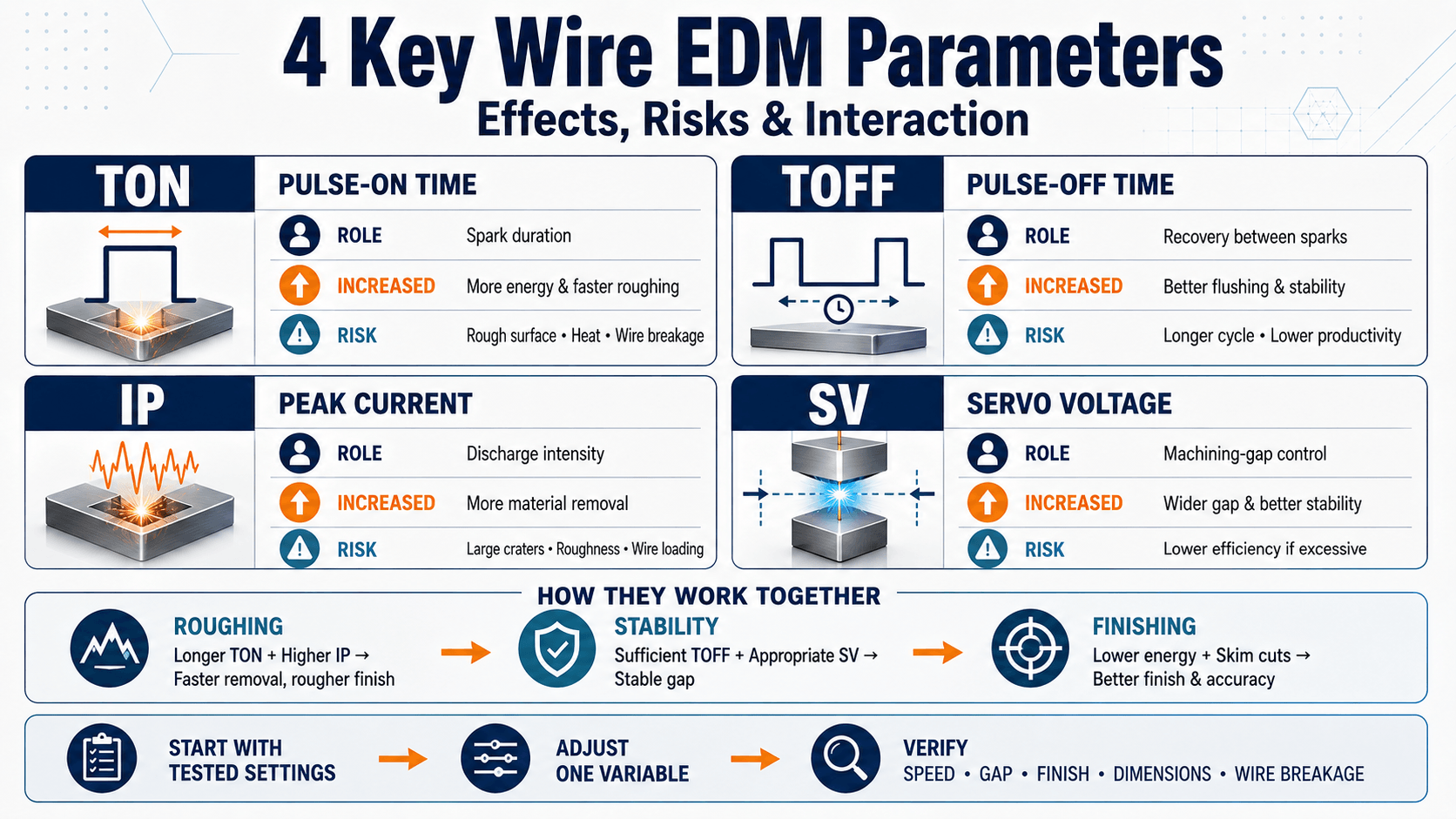
What Other Wire Cut EDM Settings Matter?
The four parameters above provide a useful framework, but they are not the only variables affecting the wire cut EDM process. Other important settings and conditions include:
- Wire tension: Appropriate tension reduces vibration; excessive tension raises breakage risk.
- Wire feed: Fresh wire supports consistency, while high feed increases consumption.
- Wire diameter and type: These influence kerf, corners, current, and suitability.
- Flushing and water condition: Effective debris removal supports stable discharge.
- Material and thickness: Electrical and thermal properties change process requirements.
- Corner and taper strategy: Compensation manages wire lag and geometry.
Optimization must therefore address the complete process, not only four settings.
How Does AccuteX Support Stable Parameter Control?
With more than 26 years of team dedication to wire cut EDM innovation and research, AccuteX develops technology for accuracy, stable discharge, and efficient production.
Guided by TECHNOLOGY, EXCELLENCE, INTEGRITY, and PARTICIPATION, we combine machine development, service, and knowledge sharing to support long-term customer success.
AccuteX controllers can optimize parameters according to wire diameter, corner angle, arc radius, and thickness. Wire diameters can be matched with tension and speed settings, while cutting speed and discharge gap voltage can be recorded for process review.
Together with automatic threading, smart monitoring, and Industry 4.0 integration, these capabilities support repeatability and reduced intervention. The goal is balanced productivity, accuracy, finish, and reliability.
Frequently Asked Questions About Wire EDM Parameters
Are These the Only Four Parameters in Wire EDM?
No. They are four core electrical and gap-control inputs. Wire, flushing, dielectric, material, thickness, and compensation also affect performance.
Which Wire EDM Parameter Has the Greatest Effect on Cutting Speed?
It depends on the machine and workpiece. TON and IP often strongly affect removal because they control energy, but TOFF, SV, and flushing determine stability.
Which Parameters Affect Surface Finish?
TON and IP influence crater size. Lower-energy conditions and planned skim cuts generally improve roughness, while gap stability, flushing, and wire condition also matter.
Can the Same Parameters Be Used for Every Material and Thickness?
No. Conductivity, thermal properties, height, geometry, wire, and flushing change the required settings. Start with validated data for the actual machine and application.
Selecting the Right Wire Cut EDM Solution
Understanding these four parameters helps evaluate capability, diagnose instability, and balance speed with quality. Success ultimately depends on the generator, controller, wire and dielectric systems, machine structure, and application data.
For a new application, provide AccuteX with the drawing, material, thickness, tolerance, finish, volume, and automation requirements. Our team can help identify a suitable machine and process strategy.