

Summary

- What Is EDM?
- What Is Wire Cut EDM and How Does It Work?
- EDM vs. Wire Cut EDM: What Are the Key Differences?
- Typical Applications of Die Sinker EDM and Wire Cut EDM
- What Are the Advantages and Limitations of Wire Cut EDM?
- How Do You Choose Between Die Sinker EDM and Wire Cut EDM?
- How Should You Select a Wire Cut EDM Machine?
- Why Work with AccuteX?
- Frequently Asked Questions About EDM and Wire Cut EDM
Electrical discharge machining (EDM) is widely used when conventional tools cannot efficiently achieve the required geometry, accuracy, or surface quality. However, buyers and engineers often ask: What is the difference between EDM and wire cut EDM?
The direct answer is that EDM is the broader machining category, while wire cut EDM—also called wire EDM or WEDM—is one type of EDM. In everyday industry discussions, "EDM vs. wire cut EDM" usually means die sinker EDM versus wire cut EDM. Both processes remove electrically conductive material through controlled electrical discharges, but they use different electrodes and produce different types of features.
What Is EDM?
EDM stands for electrical discharge machining. It is a non-contact process that removes material through a series of controlled electrical sparks between an electrode and a conductive workpiece. A small gap remains between them, while dielectric fluid controls the discharge, cools the machining area, and carries away eroded particles.
Because it applies almost no mechanical cutting force, EDM can machine hardened steel, carbide, titanium, and other difficult-to-machine conductive materials. Electrical conductivity generally matters more than hardness.
EDM includes several processes. The two most common are die sinker EDM, which uses a shaped copper or graphite electrode to form a cavity, and wire cut EDM, which uses a continuously moving wire electrode to cut a programmed profile.
What Is Wire Cut EDM and How Does It Work?
Wire cut EDM uses a thin metal wire as the electrode. A CNC system guides the continuously fed wire along a programmed path while precisely controlled sparks remove material. Deionized water is commonly used as the dielectric and flushing medium.
The wire does not work like a mechanical saw and never touches the part. This non-contact action allows wire EDM to produce narrow kerfs, fine contours, small internal radii, and accurate tapers with minimal risk of cutting-force deformation.
Wire EDM is primarily used for through-cuts. Machining may begin at an outside edge or through a pre-drilled start hole for a closed internal profile.
EDM vs. Wire Cut EDM: What Are the Key Differences?
When "EDM" refers to die sinker EDM, the practical differences are:
| Comparison | Die Sinker EDM | Wire Cut EDM |
|---|---|---|
| Electrode | Shaped copper or graphite electrode | Continuously fed metal wire |
| Best suited for | Cavities, recesses, and complex 3D forms | Accurate profiles, tapers, and through-features |
| Machining access | Can create blind cavities | Normally requires a through-cut path |
| Preparation | May require custom roughing and finishing electrodes | Requires wire setup and CNC programming, but no shaped electrode |
| Common dielectric | EDM oil | Deionized water |
| Typical parts | Mold cavities, ribs, slots, and internal forms | Punches, dies, inserts, and precision contours |
Part geometry is usually the deciding factor. A blind three-dimensional cavity generally calls for die sinker EDM. A high-accuracy profile that passes through a workpiece is normally better suited to wire cut EDM.
Typical Applications of Die Sinker EDM and Wire Cut EDM
Die sinker EDM is selected when a wire cannot pass through the required feature. A custom electrode reproduces the desired form in the workpiece. Applications include mold cavities, deep ribs, blind slots, pockets, and detailed internal contours. Electrode production and wear compensation affect lead time and cost.
Wire cut EDM is a strong choice for accurate, repeatable through-profiles. Since cutting force is extremely low, it can machine thin sections, delicate features, and hardened workpieces with a reduced risk of deformation. Common applications include:
- Stamping punches and dies
- Mold inserts and precision tooling
- Fine slots, narrow openings, and tapered contours
- Medical and electronic components
- Electric vehicle, aerospace, and semiconductor parts
- Prototype and low-volume precision components
Modern systems may support automatic wire threading, multi-pass finishing, intelligent parameter control, remote monitoring, and unattended machining to improve consistency and machine utilization.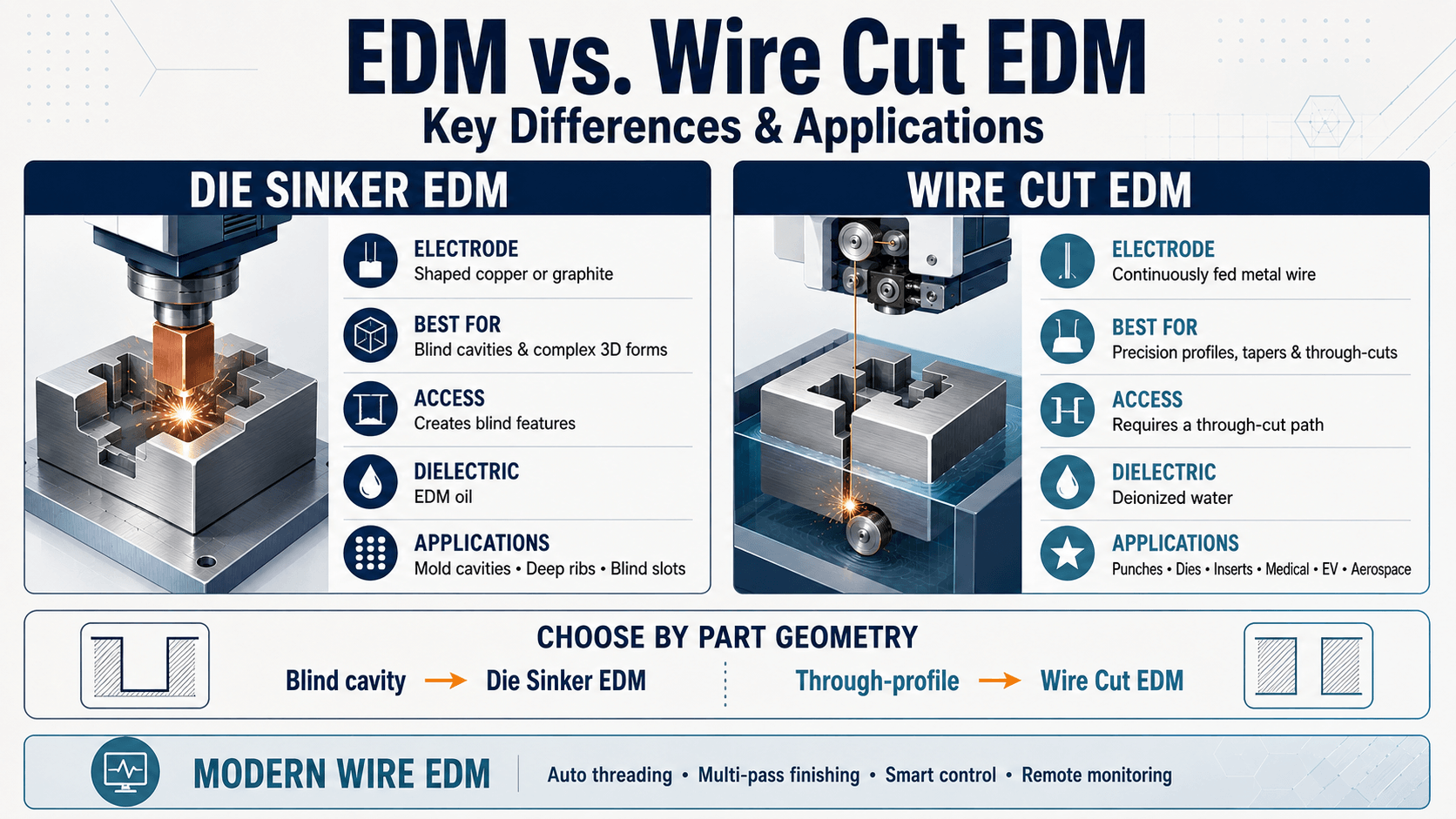
What Are the Advantages and Limitations of Wire Cut EDM?
Wire EDM can machine parts after heat treatment, avoiding dimensional changes caused by later hardening. It produces fine contours without tool pressure, while skim cuts can improve accuracy and surface finish.
However, the material must conduct electricity, and the wire needs a continuous cutting path. It cannot directly create a blind-bottom cavity. Productivity depends on material, thickness, wire diameter, flushing, geometry, tolerance, and finish, so buyers should not compare machines by maximum cutting speed alone.
How Do You Choose Between Die Sinker EDM and Wire Cut EDM?
At AccuteX, we recommend beginning with five practical questions:
1. Is the Feature a Through-Profile or a Blind Cavity?
Choose wire EDM for a profile that passes through the part, and sinker EDM for a cavity or internal form with a controlled bottom.
2. Is the Workpiece Electrically Conductive?
Both require conductive material. Tool steel, stainless steel, carbide, copper, aluminum, and titanium may be suitable with the correct parameters.
3. What Accuracy and Surface Finish Are Required?
Define tolerance, corner radius, taper, straightness, and surface roughness. A rough cut differs greatly from a precision insert requiring several finishing passes.
4. What Are the Workpiece Size, Thickness, and Weight?
Machine travel, tank size, table capacity, axes, and flushing must match the part—not just the headline accuracy specification.
5. What Level of Automation Is Needed?
For long jobs or mixed production, assess automatic threading, restart reliability, monitoring, core removal, controller usability, and Industry 4.0 connectivity.
How Should You Select a Wire Cut EDM Machine?
Once wire EDM is selected, match the machine to present work and future goals. Consider travel, cutting thickness, taper and fine-wire capability, accuracy, repeatability, surface finish, automatic threading, controller functions, energy efficiency, support, and total cost of ownership.
AccuteX develops solutions for different precision and productivity needs, including high-resolution motion control, stable discharge control, intelligent parameters, fine-wire capability, automatic threading, smart monitoring, and manufacturing integration. We match capability to the part, tolerance, material, volume, and automation plan.
Why Work with AccuteX?
With more than 26 years of team dedication to wire cut EDM innovation and research, AccuteX is guided by TECHNOLOGY, EXCELLENCE, INTEGRITY, and PARTICIPATION. We provide high-quality machines and service while pursuing mutual growth with customers and suppliers.
The best decision begins with the part. Sinker EDM suits blind cavities and complex 3D forms; wire EDM suits precise through-profiles, fine contours, and tapers. Clear geometry, material, accuracy, productivity, and automation requirements make the correct process easier to identify.
If you are evaluating an EDM machine, share your part drawing and production requirements with AccuteX. Our team can help identify the appropriate process and machine configuration.
Frequently Asked Questions About EDM and Wire Cut EDM
Is Wire Cut EDM the Same as EDM?
Wire cut EDM is one type of electrical discharge machining. EDM is the broader category, which also includes die sinker EDM and EDM drilling.
Can Wire EDM Cut Hardened Steel?
Yes. Wire EDM can machine hardened steel as long as it is electrically conductive, making the process valuable for punches, dies, and heat-treated tooling.
Can Wire Cut EDM Make Blind Holes or Cavities?
Wire EDM normally creates through-features and cannot directly produce a blind-bottom cavity. Die sinker EDM is generally used for blind cavities, while EDM drilling may create small start holes or deep holes.
Which Process Is More Accurate: Sinker EDM or Wire EDM?
Both can achieve high precision when the machine, tooling, parameters, and environment are properly controlled. Wire EDM excels at precise through-contours, while sinker EDM is suited to accurate cavities and complex internal forms.